community-based, non-corporate, participatory media
Administration estranges constituents in favor of manufactured consent
by Megan
Friday, Feb. 14, 2003 at 5:17 PM
mflocken@andrew.cmu.edu
"The opinioned, who have the right to listen, are ever more numerous, while the opinionators, who have the right to make themselves heard, are ever fewer." Eduardo Galeano, Upside Down
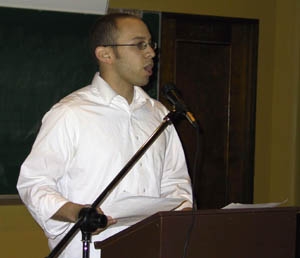
Wednesday night a group of student poets from the University of Pittsburgh and Carnegie Mellon University gathered at the Cathedral of Learning to share their voices. The poetry reading was a continuation of a series began during the Pittsburgh Peace Convergence of January 24-26., and also was meant to coincide with a national event called "Poetry against the War" , which was created as a response to Laura Bush?s decision to cancel a poetry symposium scheduled for Wednesday when she learned that some of the poets would be reading poetry with anti-war themes.
In all, thirteen students from the two schools read. Some brought their own poetry with them, and some borrowed the voices of poets in past wars. The poets took on a variety of themes, from god to the atom bomb, to specific criticisms of the Bush Administrations? policies.
Many challenged the inevitability of war, and sought to emphasize the human cost associated with it. Scott Silsbe, an MFA student at Pitt, used the analogy of a battlefield with a window so that the soldiers could look at themselves rather than their opponents.
Kevin Gonzales, a senior in the Creative Writing program at CMU, made a more plaintive query. "Is the bridge to the future built with the rocks we throw at each other" he asked in "Five Stripes at Half Mast".
Organizers Marhall Warfield, Emily Cleland, Gail Giewont, Cate Hodorwicz and Oliver Khan hope to continue the series of anti-war poetry, much as poets spoke out against the war in Vietnam. To do so, they hope to involve more of the campus communities at both schools.
About 50 students attended Wednesday evening?s event, although many more attended a reading in Market Square at noon of the same day. At that event several prominent area poets read.
"For poets, this is a chance to get together and reassure ourselves that everyone hasn't gone completely insane," said Jim Daniels, director of creative writing at Carnegie Mellon. "In my dreams, I imagine that this reading is unnecessary. Unfortunately I don't think so."
National Poetry Against the War Day was created as a response to Laura Bush?s cancelled symposium, "Poetry and the American Voice," which endorsed a very prescriptive definition of the sound of the poetic voice.
Sam Hamill, editor, translator, essayist, and author of more than thirty books and thirteen volumes of poetry, was invited by Laura Bush to a White House Symposium entitled, "Poetry and the American Voice." Hamill had become increasingly despondent about the Bush administration?s crash course to war, and thought the forum would be perfect to present an organized dissent. On January 28th Sam Hamill addressed an open letter to his fellow poets, asking for submissions of conscience concerning the possible war in Iraq. He felt that a Poets Against the War campaign similar to the one organized against America?s involvement in Vietnam must be resurrected.
When news of Hamill?s efforts spread, Laura Bush postponed the symposium indefinitely. Her press secretary, Noelia Rodriguez, read a statement from the first lady saying that she believes it would be "inappropriate to turn a literary event into a political forum."
In response, Wednesday, the intended day of Mrs. Bush's symposium, was declared National Poetry Against the War Day. Across the nation over 160 poetry readings brought thousands together to voice their opposition to the administration?s intent to wage war against Iraq regardless of world opinion and the prevailing sentiments of the United Nations Security Council.
Poetsaginstthewar.org reports that to date over 5,300 poets have submitted poems or personal statements to express their opposition to the Bush administration's imminent war with Iraq. Doing so continues a historical connection between administrative plunder and the poetic voice. From Thoreau to Wilfred Owen, Ginsberg to Yusef Komunyakaa, poetry has articulated the criticisms of murderous policy. Laura Bush, a former librarian, seems to ignore this historic link in favor of manufacturing a unified American voice.
For more information or to submit poetry, please contact
eac23@pitt.edu or poemsforpeace@yahoo.com
