community-based, non-corporate, participatory media
Save Tibet! Boycott Beijing 2008 Olympic Games
by Everyone Group
Monday, Mar. 24, 2008 at 11:37 PM
info@everyonegroup.com
Gruppo EveryOne is promoting a petition (www.petitiononline.com/fortibet) and an international campaign to ask for an immediate halt to the harsh sociocultural repression underway in Tibet, a repression perpetrated by the Chinese authorities towards thousands of innocent people.
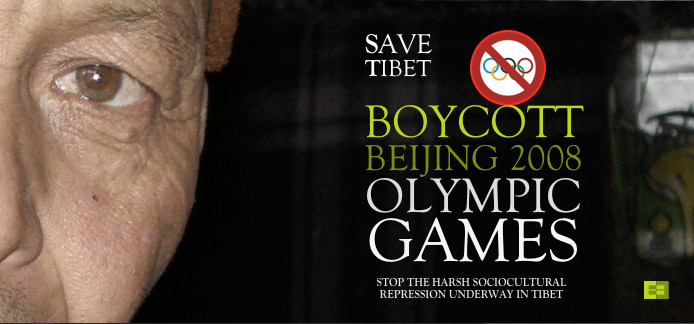
Save Tibet. Boycott Beijing 2008 Olympic Games
Sign the Petition: http://www.petitiononline.com/fortibet
Gruppo EveryOne is promoting a petition (http://www.petitiononline.com/fortibet) and an international campaign to ask for an immediate halt to the harsh sociocultural repression underway in Tibet, a repression perpetrated by the Chinese authorities towards thousands of innocent people.
The leaders of EveryOne, the authorities and people of goodwill who sign the petition below are promoting the Boycott Campaign of the Beijing 2008 Olympic Games and sporting and cultural events in the People’s Republic of China. They will also be supporting the “Beijing 2008 Gold Medals for Human Rights” campaign, with gold medals coined by EveryOne Group being awarded to all the athletes who decide not to take part in the Olympic Games out of solidarity with the people of Tibet.
Petition: http://www.petitiononline.com/fortibet
One of the most serious human rights emergencies is taking place in Tibet, a country situated north of the Himalayas, covering an area of 2,5 million square kilometres: more than eight times the size of Italy. The Tibetan population numbers about 6.5 million inhabitants, compared to the 7.5 million colonists gradually introduced into the country by the Chinese Government over the years. Tibet had been free and independent for centuries; its right to independence is documented by three resolutions approved by the United Nations in 1959, 1961 and 1965. Following the invasion by the Chinese Army – between 1949 and 1950 – and its ruthless repressive politics, over two thousand years of Tibetan history and culture are in serious danger of being destroyed. Let us remember that during the occupation, and after the annexation, numerous barbarous acts have been carried out by over 40,000 invasion troops who already in the period of 1950-1980 murdered over two million Tibetans and destroyed an incomparable patrimony of humanity: over six thousand temples and incalculable number of works of art. Thousands of dissidents, intellectuals, religious men (guilty of not accepting this persecution) have been imprisoned; language, religion and cultural traditions are being denied; the environment, of breathtaking beauty before the invasion, has been subjected to deforestation and sacking of resources, actions that have led to an ecological catastrophe and the progressive impoverishment of the country. Since 1959 the Dalai Lama has lived in exile. In the meantime his country has been reduced to conditions of extreme hardship: the Tibetans’ standard of living is one of the lowest in the world, while the introduction of Chinese colonists is turning the Tibetans into an even smaller minority year by year. Today the drama foreseen in 1931 by the 13th Dalai Lama (the predecessor of the present one) has finally taken place:
“We have to be ready to defend ourselves or our spiritual and cultural traditions will be destroyed, the names of the Dalai and Panchen Lamas will be cancelled out, our monasteries will be looted and reduced to rubble, the monks and nuns will be murdered or kicked out. If we do not protect our people, we will become slaves of our torturers, forced to wander around like beggars, without hope.”
Since March 13th, 2008 Tibet has been witnessing the protest of its people against the persecutory politics of the Chinese Government. The Chinese authorities have reacted with even more severity than in the past. Many monks have been arrested, while the police, firing into the crowd of demonstrators has caused a hundred or so victims so far. A situation the Tibetan government in exile has documented and the Chinese Government has tried to conceal, declaring that only thirteen people have been killed while defining them “troublemakers” and “criminals. History teaches us that the propaganda of persecutory regimes has always initiated campaigns directed at criminalizing the victims according to a precise strategy, a strategy finalized at justifying violations and forms of destruction: the European colonists towards the Native Americans, the Nazis towards the Jews and the other minorities they targeted. The persecution being carried out by several European states towards the gypsy people (which is taking place among the indifference of the rest of the world) makes use of the same kind of propaganda: “Zero tolerance against a nation of criminals”. The exact same words used by Qin Gang, the spokesman of the Chinese Foreign Office in response to an appeal in support of Tibet by Pope Benedict XVI. On March 18th, 2008 Wen Jiabao, the Chinese Prime Minister, to prevent possible boycotting campaigns from the Dalai Lama laid on him the blame for the Tibetan victims killed by Chinese authorities, accusing him of “inciting a boycott of the Olympic Games in Beijing in August of this year”.
This is why the Dalai Lama is avoiding talking of the possibility of saying NO to the Bejing Olympics: he does not want further bloodshed. At the same time though, from his exile in Dharamsala (India) he has cried out to the free world for help: “The repression is getting worse, leading to terrible and frightening violations of human rights. At the same time religious freedom is being denied and spiritual matters are being politicized.”
In the meantime the monks, intellectuals and leaders in exile have started a protest march from India to Tibet, asking for an end to the bloody Chinese occupation, and asking that all countries and human beings who believe in the necessity to safeguard human rights to boycott the next Olympic Games in Beijing. The international community seems frightened by the idea of a boycott, due to the huge economic and political interests revolving around the Games.
Showing ourselves to be cowardly and indifferent to a tragedy of such huge proportions, however, would be the greatest mistake and it would make us all accomplices of the bullies who are constantly perpetrating violations of people’s fundamental rights, which contrast with civil coexistence and with the principals of liberty and dignity that all human beings are entitled to. The Olympic Games have always represented a moment of celebration of the brotherhood between peoples (historically all conflicts were suspended while the Games were underway). What is more, the Games are an occasion for reaffirming the universal value of human rights and for preventing the violation of democratic rights. The Chinese Government is failing to respect all of this.
After the shocking events in Burma (where hundreds of Buddhist monks who were demonstrating peacefully were massacred) even more serious episodes are taking place in Tibet and the oppressors are not being reached by clear warnings from determined and influential voices that will induce them to change their attitude and walk along the path of respect for human rights.
Up to now the recommendations from human rights groups and international political parties have gone unheeded, as unfortunately was the appeal from the Dalai Lama to the Chinese authorities - in which he asked them to abandon the use of force in repressing the peaceful and democratic protests of the Tibetan people. Fear and indifference, on the other hand, weakens his voice that invites them to seek the path of peace and respect for peoples.
EveryOne Group invites nations, sports federations, individual athletes, sports journalists, and sports fans to reflect carefully on the result of ignoring the suffering and losses of the Tibetan people and celebrating the Olympic Games as usual. What value would the athletes’ feats have? What would the national anthems sound like? What light would the medals reflect?
We are reminded of the 1936 Olympic Games: the choice fell upon Berlin, a controversial choice seeing Germany was about to enter the Hitler period. The Games became just an excuse for demonstrating Germany’s supremacy to the whole world: new monumental building projects (among which the splendid Olympic Village) and a German team which trained scrupulously for months in the Black Forest, from where it emerged in top form after strict training. There were no lack of protests against Hitler’s Games, nor lack of contradictions: the United States threatened, through Roosevelt, to boycott the games but it all came to nothing.
Roosevelt sent an envoy to Germany to check out the real situation, but it was Avery Brundage who crossed the ocean, the future president of the International Olympic Committee with ultra-conservative and racist leanings. His report was therefore a positive one and the United States decided to take part in the Games. Even Hitler cleaned up his act a little: in the German team he included a handful of Jewish athletes: all this while the anti-Jewish laws were already in force. Therefore, among a display of swastikas, on August 1st, 1926, the German middle-distance runner, Erik Schilgen lit the Olympic torch with the torch that had been carried by 3000 torch-bearers from Athens. A
few years later, to choose a significant example, all the Jewish players of Ajax, the football team of the Amsterdam ghetto founded by the brothers Han and Johan Dade, were deported to the Nazi concentration camps amidst the indifference, mixed with dismay, of the international community. We will not allow the same thing to happen with the People’s Republic of China.
China cannot represent the Olympic spirit of brotherhood and friendship, the way it cannot host art and cultural events that are messengers of solidarity. EveryOne Group is asking all athletes, Italian and international, who have planned to take part in the Beijing Olympics to boycott their participation there. But this itself is not enough, because for a boycott to be effective towards a government whose arrogance and abuse of power seems to be without limits, it must include all sporting, cultural and theatrical events, and all venues. EveryOne Group (but also influential figures of contemporary culture, like that of the French philosopher Bernard Henry-Levy) are asking the athletes not to show their talent on the soil of a country that does not recognise human rights; it is asking all the artists who have tours, concerts and shows planned in China to cancel them: the concerts must be stopped until the Tibetan trumpets are allowed to sound out again in liberty and peace; the performances must stop for as long as we can hear the cries of the thousands of innocent people demonstrating peacefully, people who are being forcibly repressed, arrested, humiliated and killed by the Chinese soldiers.
EveryOne Group points out that boycotting is a form of action in support of human rights that has obtained important results right from the late 19th Century. Its effectiveness is indisputable because is it based on the same principles that have made coming out on strike a fundamental tool for the workers’ cause throughout the world. Boycotting is a non-violent action, aimed at isolating the entity that violates human rights and interrupting any form of collaboration with it. One of the most significant victories obtained through boycotting was the abolition of apartheid in South Africa. To those who claim that the 2008 Olympic Games will bring benefits to all the Chinese people and visibility to Tibetan dissidents, we reply that the Games, if held according to plan, will only result in strengthening the present regime, penalizing the persecuted minorities even more. At the same time the news reaching the media and international observers will be carefully filtered by government propaganda. A boycott, on the other hand, is a clear response to the voice of prevarication: “There is no price for the freedom of a people; there is no price for innocent blood”.
The leaders of EveryOne Group, the authorities and people of goodwill who support the Petition and the Boycotting Campaign of the 2008 Olympic Games (as well as sporting and cultural events in China) will also be supporting “Beijing 2008. Gold Medal for Human Rights”, with gold medals (coined by the Group in gold-coloured metal) awarded to all the athletes who decide not to take part in the Olympic Games or other sporting events out of solidarity with the people of Tibet. The medals will also be awarded to journalists, intellectuals and artists who sign the petition and take part in the campaign by boycotting cultural and theatrical events with the government of the oppressors.
For EveryOne Group: Roberto Malini, Matteo Pegoraro, Dario Picciau, Glenys Robinson and 20 other members
Sign Petition: http://www.petitiononline.com/fortibet
Contact:
Gruppo EveryOne
Tel: +39 334 8429527 :: Fax: 055 0518897
info@everyonegroup.com :: http://www.everyonegroup.com
Another View from Tibet
by Repost by CarlD
Tuesday, Mar. 25, 2008 at 1:02 AM
Raccoon Twp
[Here's a view from inside Tibet written by an old roommate of mine, who spent his earliest years in a Japanese-American internment center somewhere out West. In the 1980s, he moved to Japan, and took up journalism. --CarlD]
Endgame for the Dalai Lama:
Black Hat Sect Dismantling Power Base
New America Media, News analysis
By Yoichi Shimatsu
Posted: Mar 21, 2008
Editor’s note: The façade of Tibetan unity has unraveled and along with it, the Dalai Lama’s power base. Yoichi Shimatsu, former editor of the Japan Times Weekly in Tokyo, was executive producer of the video documentary “Flight of a Karmapa” (Nachtvision 2002) taped in the Tsurphu area of Tibet, the Mustang region of Nepal, Sikkim and Dharamsala.
Hezuo, Gansu Province – For decades, the Beijing government had recognized the Dalai Lama as its sole negotiating partner in Tibetan affairs. For the officialdom, it was simpler to deal with a single person -- the “pontiff” of Tibetan Buddhism – to control the entire ethnic population. The façade of Tibetan unity was convenient to both sides but now it has unraveled, and it’s the endgame for the Dalai Lama.
By ordering the monks of his Gelugpa or Yellow Hat sect to hold peaceful rallies on the 49th anniversary of the Chinese invasion, the Dalai Lama -- unwittingly -- ignited pent-up emotions among Lhasa residents. Scenes like the head bashing, stoning and kicking of a prostrate bicycle owner arose from popular grievances against runaway price inflation and perceived discrimination against Tibetans in their own land. Such cruelty, regardless of past injustices, has nothing to do with Buddhist teachings but arises from the human condition.
Unfortunately for the Dalai Lama, the loyalists in his once-powerful organization inside Tibet are being selectively investigated, arrested and detained for causing the violence. The Beijing government has repeatedly stated that only a small minority of Tibetans loyal to the Dalai Lama were involved in the protests. Whatever its legal flaws, there’s more than a grain of truth in the official assertion.
Amid the mayhem and anarchy, a decisive factor in the Tibetan equation has gone practically unnoticed: Key major players did not join or support the protests:
-- The Panchen Lama, a top prelate of the Gelugpa or Yellow Hat school, second in rank only to the Dalai Lama himself, has spoken in no uncertain terms against the rioting and instead backed the government.
-- Leaders of the Nyingma and Sakya schools, as well as the native Bon religion, did not endorse the protests and are tight-lipped about the wave of arrests.
-- Laymen with the re-ascendant Kagyupa or Black Hat school, are furious with the Dalai Lama after being targeted by Gelugpa supporters during the horsemen’s raid on the Hezuo local district office in south Gansu and in several counties in Sichuan Province.
In this negative light, the rallies by the Gelugpa monks seemed a desperate bid to reassert the Dalai Lama’s authority by accusing their Tibetan rivals of being “collaborators” and presenting themselves as the “resistance.” Due to the unintended violence, however, the Yellow Hats find themselves as the odd man out. Following the crackdown, rival sects are moving to dismantle the remnants of the Gelugpa organization, which had the monopoly of power over the Tibetan Autonomous Region (TAR) and other districts as recently as five years ago.
If the façade of Tibetan unity was convenient, it now no longer serves.
In January 2000, the Chinese view of the Dalai Lama started to undergo a radical change during the affair known as the “Flight of the Karmapa” - covered in a documentary by Nachtvision. The Karmapa is the head lama of the Kagyupa, or Black Hat school, which ruled Tibet until the reign of the 5th Dalai Lama began in 1642.
At the turn of the millennium, the teenage Karmapa, born Ogyen Trinley Dorje, began a secret journey from his seat in Tsurphu monastery, west of Lhasa, to Sikkim in north India to recover the mystic Black Crown of the Kagyupa. In the bid to strengthen his nomination against other contenders, the Karmapa rode horseback on a tortuous path through the frozen wilderness of Nepal’s Mustang region. At the 4,500-meters altitude Thorong-La Pass, he was separated from his Nepalese Kagyupa guide and whisked aboard a mountain-rescue helicopter. He soon turned up under virtual house arrest near the Dalai Lama’s headquarters in Dharamsala, India.
As told by his guide, the Venerable Gyaltsen Rimpoche, nicknamed the “Tall Manangi,” the Ogyen Trinley had to retrieve the charismatic crown because “in Lhasa the Karmapa was rising and becoming more popular, so the Gelugpa did not like it and the situation was becoming dangerous for him.” Only the magic talisman could turn the tables on the powerful Yellow Hats.
In the eyes of many Kagyupa monks, the Karmapa has been abducted by the Dalai Lama’s exile government and remains a hostage to the senior leader of a rival sect. The Black Hats responded furiously with demands to Beijing that Gelugpa monks should be stripped of their control over the Tibet province budget and other privileges.
Feeling sorely betrayed by the Dalai Lama, who had earlier backed the appointment of Orgyen Trinley as Karmapa, Beijing consented to the Black Hat’s harsh demands. Thus ended the Yellow Hats’ monopoly on power inside Tibet. Since then, the local governments of many Tibetan zones have been taken over by laymen loyal to the Black Hats. Hezuo, the scene of the horsemen’s well-publicized raid, is the site of the Kagyupa’s Milarepa Shrine. Horses were used in the attack because the raiders came from the Xiahe district, the stronghold of the rival Gelugpa’s Labrang Monastery.
This realignment of sectarian power in Tibet, which can be compared with the Protestant Reformation in Europe, is only now coming to light in public discourse after the Lhasa riots. A People’s Daily editorial, titled “No return to old Tibet” (March 18), stated: “the political exile (Dalai Lama) has continued his rule with an iron fist that smashes any challenge to his power from anyone or any sect. . . . Local Tibetans have managed their affairs well without his interference.”
In private, many exiles across the Himalayas, including former Khampa guerrillas who fought the Chinese army in the 1960s, recount disturbing allegations of the Dalai Lama’s security team's involvement in the murdering of his critics by poisoning and bombing. This dark side of intra-Tibetan intrigue is yet to be factually uncovered before world opinion.
In an ultimate irony, the only person who can prevent the coming demolition and disgrace of the Gelugpa school is Gyeltshen Norbu, the Beijing-appointed Panchen Lama.
The Panchen Lama probably won’t rush to their defense, not after pro-Dharamsala lamas lobbied furiously against Beijing’s attempt to appoint the young lama as a delegate to the National People’s Congress, held in early March, arguing that he was not yet 18 years of age. To avoid controversy, Beijing reluctantly conceded, even though the official birth date of Gyeltshen Norbu was February 13, 1990, making him 18 and eligible.
The Panchen Lama is likely to receive Buddhist VIPs at the Beijing Olympics. An audience and blessing from the bright young monk will certainly win international support for his confirmation of the next reincarnation of the Dalai Lama. It is the traditional custom for the Panchen Lama to confirm the reincarnated Dalai Lama and vice versa. By contrast, high-ranking monks have scoffed at the Dalai Lama’s idea of forming a committee to elect a successor.
The recent uprising in Lhasa, despite its grim pathos, is a reminder of the tragic 1959 insurrection that resulted in the deaths of thousands of Tibetans. In both cases, the 14th Dalai Lama badly miscalculated the divisions among his own people, Beijing’s strategic determination, and the moral hypocrisy of the international community.
In the Buddhist view, all things come full circle. In the 17th century, the 5th Dalai Lama called in a Mongol general to overthrow the Karmapa’s theocracy. Today, the Karmapa’s men are ousting the Gelugpa power structure. Ceaseless change is unstoppable, taught Sakyamuni Buddha. Thus, attachment only results in suffering – our attachment to wealth, power, pride, respect and, most of all, to love, the meanest vice yet highest virtue of human existence. Not even his bitter opponents can dispute the deep love of His Holiness the Dalai Lama Tenzin Gyatso for his homeland, Tibet. How difficult it must be now, to let go.
