community-based, non-corporate, participatory media
where do we go from here?
by david
Tuesday, May. 06, 2003 at 5:38 PM
421-7716
"Where do we go from here?"
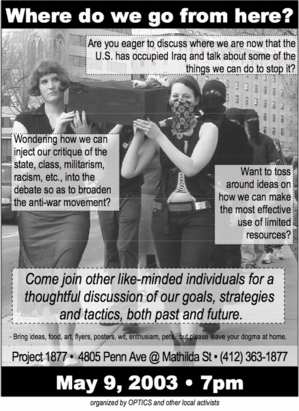
Please download the flyer at http://www.andrew.cmu.edu/user/dmeieran/war_pdfs/where_do_we_go.pdf and spread the word.
What's your movement?
by david
Wednesday, May. 07, 2003 at 4:09 PM
As warm-up for friday's meeting, I'm hoping that some might be interested in having on-line discussion about some of the questions we "anti-war" activists are now asking ourselves.
To start things off, I'd love to hear how folks respond the these questions:
What sort of movement do you want to be part of? A "peace movement," a "peace and justice movement," an "anti-war movement", "anti-imperialist movement," a "global justice movement" or some other thing? What are the differences between these these different movements?
These are not unimportant semantic quibbles. I believe they represent underlying foundational questions about the goals and strategies we choose to support as both individuals and groups.
Here are my own thoughts (at least as of this afternoon).
To me, "peace" is a empty vessel of a word used by beauty contestants, complacent liberals, and swarmy politicians. Peace, in and of itself, is not the answer. Justice can trump peace. While that seems like an argument for the "peace and justice movement," one worry is that the "justice" part gets lost in the shuffle. The phrase "anti-war" isn't much better, since has been interpreted in two ways. Some groups use the phrase to simply mean "stop the war" (and nothing else); others use it more broadly to express their opposition to both the war itself but the underlying imperialist agenda, the military industrial complex, and related economic institutions and values that precipitate it.
At first glance it might seem that the peace movement (or the anti-war movement in the weak sense) might be compatible with the anti-war movement in the broader sense of the term. But here are two obvious examples that make an alliance between the two. (1) Despite the fact that the the war on Iraq and the US-supported occupation of Palestine are directly linked, Palestinian issues received scant attention in the past 6 months of anti-war activism in this city. (2) Some tactics focus on undermining the economic bedrock of US imperialism. So when some in the movement target Banana Republic or reposition newspaper racks, for example, others feel that those actions are either off-topic or counter-productive to the message of "peace."
Personally, I couldn't agree more with Eleven O Clock Alchemy (of Anarchist People of Color), who eloquently sums up the problem with the peace movement like this:
I am not part of the peace movement. My movement is the anti-imperialism, anti-oppression movement. I do not want war or killing, certainly not. But to ask another question, do we need a comfortable, air-conditioned, sound-tracked, airbrushed, leather-upholstered SUV-driving, sweatshop-clothes buying, racial profiling, meat-eating, bourgeois, mother-fucking peace?" If peace means that we go right back to the nightmare that we were living before the war, then I don't want peace. I want a revolution.
(see http://www.illegalvoices.org/apoc/knowledge/articles/ideas/revolution.html)
In a similar vein, Tariq Ali makes the convincing argument that the movement should resist any attempt for peace and reconciliation ("the quisling syndrome") involving the UN and european nations. Rather, we need to challenge the imperialist forces that make a "united nations of america" possible: he advocates the formation of a global "Anti-Imperialist League" that would campaign for "the shutting down of all American military bases and facilities abroad." That, together with the anti-corporate globalization concerns of the World Social Forum, make up the long term-goals for an "anti-imperialist movement." To embrace the goals of such an "anti-imperialist movement" seems to me the only way to effectively "stop the US war, from Iraq to Flushing, Queens," as the folks at this week's Operation Homeland Resistance are chanting. (see http://www.newleftreview.net/NLR25501.shtml and http://www.homelandresistance.org)
But even the phrase, "anti-imperialist movement" is problematic because it leaves mysterious the concept of imperialism. Much like the word, "facism", its historical connotation makes it too easy for people to dismiss as empty rhetoric. So either we find a way to reinvigorate the term, "imperialism" with a more robust and contemporary set of values or else we choose another adjective altogether. I would argue that justice and self-determination are two critical values that we need to re-appropriate and to give greater prominence in our messages.
For example, another problem I see with the generic peace message that predominates in many anti-war events is that it fails to address the centrality of justice and self-determination to our moral condmenation of the war. What is the value of peace, said the war's supporters, when threats of WMD's undermine our way of life, or when it allows a brutal dictator to wreak havoc on his countrymen? (Of course, the pro-war camp is awash in profound moral inconsistencies, specious empirical propositions and fallacious inferences. But none of that vitiates their claim that peace is not the only value which deserves our moral attention.) Strategically speaking, focusing more on peace and less on justice and self-determination was a costly error for the anti-war movement. And is one that we can't afford to make again in the months ahead.
(Just to be clear, by "self-determination", I not referring to arbitrary right of an elite few in control of nations to decide what is best for their population. I'm talking about the value of autonomy as it applies to individuals and communities: they should be free to determine their own fate without the shackles of, for example, Christian morality that makes sodomy a crime in 35 states.)
Finally, I think we need to make it clear that the war-peace dichotomy is false. "Bush's Endless War" (or the "War on Terror"), the occupation of Iraq (and, indirectly, Palestine), combined with the ongoing war at home against immigrants, civil liberties and social programs, is evidence that we can be at war at the same time we are allegedly "at peace."
SF's inspiring group, Direct Action to End the War got it right in one of their recent chants: "neither their war, not their peace." I think I want to be part of a Global Justice movement. How 'bout you?
Questions as old as time
by wheatpaster
Wednesday, May. 07, 2003 at 5:21 PM
These issues have been floating around the left for hundreds of years... could there be time limits on each of these topics for discussion? I think the question of: "whats been effective and ineffective" could go all night by itself without anything close to consensus... Just an idea.
yes to time limits/no to old as time
by david
Wednesday, May. 07, 2003 at 6:01 PM
yes, we were thinking roughly 30 min/section (2-5), though i suspect we might want to allocate more time to 3 & 4.
while the work "within the system vs. work against the system" debate is centuries old, i think the contemporary manifestation of that problem raises a new set of questions about the local goals and strategies we choose to support.
anyway, in this thread i was eager to hear other people's views on what the priority issues & goals were for the movement. i just so happens that i find eleven o clock's passage about the peacement a convenient starting point.
so, wp, what's your view?
what's in a name
by nonlocal observer
Thursday, May. 08, 2003 at 12:11 AM
How about calling it a 'patriot movement', inclusive of everything discussed while maintaining the true spirit of America, freedom.
patriot
by andybot
Thursday, May. 08, 2003 at 10:42 AM
andy at indypgh.org
How about calling it a 'patriot movement', inclusive of everything discussed while maintaining the true spirit of America, freedom.
that sort of implies that:
1. freedom belong in the USA and not elsewhere and
2. we're working for freedom in the USA but not accross the rest of the world . . .
neither of which are healthy or accurate views, i think. just my two cents. i agree with much of what you said, david, about the "peace" and "anti-war" movements not being quite enough . . . i don't really feel like right now i have a coherent enough view of all this to make any suggestions, but i'll be interested in what comes out of this discussion. post something to indymedia after the meeting!
andy
Which direction to move? Every direction!
by Dean Gerber
Saturday, May. 10, 2003 at 12:39 AM
It seems quite unfortunate to me that some people seem to be focusing on which types of action we should support in pursuit of our common goal, when quite frankly, most any action that educates an audience beyond ourselves serves our purpose. Whether that action is talking to friends, participating in electoral politics, legislative lobbying of all sorts, marching in the streets in a permitted march, particpating in organized, or even not so organized civil disobedience, or any variety of other methods, in the grand scheme of things simply doesn't matter as much as getting the greatest number of people involved. Different types of actions will reach different types of people. What does matter is that people participate. The more, the better. And so I believe that our focus should not be which actions to take, but how to best foster and support all of them.
Disrespecting any one type of action disrespects all of them. And so perhaps the most simple, inclusive and best way to proceed is to allow each individual and group to pursue the goal the way they see fit, and to support each others tactics wherever our own beliefs make it possible. Trying to micromanage other people and groups certainly won't work. It may be that for some types of events, not everyone in every group will feel comfortable. So lets all focus on working together when and where we can.
The message of the movement, similarly, will vary depending on the people and/or group organizing the event, and the latest headlines. I think it would be a mistake to try to force fit the entire movement into a limited direction, because in doing so, we might wind up alienating most of the people involved. Each of us comes from a different background and have a slightly different perspective on what is going on. We also have different ideas about how to resist and which topics to focus on. This is not a weakness. In fact it is our greatest strength because it is in that diversity that we can all gain a more complete understanding of the situation and better counteract the propoganda of those that we oppose.
That being said, it may be best for future individual events, that we limit the scope of the issues in order to present a more coherent picture that the average person on the street can more easily understand. However, we also need to be careful not to ignore important issues.
I personally would rather organize 5 well-done, limited-scope, 1-hour events over the course of two months, than organize 1 five-hour event with a dozen issue points that takes two months to organize. This would allow for a diversity of issues, a diversity of tactics, a diversity of organizers, and a chance for people to interact in different ways. I also firmly believe that it would mean less of a time commitment from each of us since we would most likely be able to spread the work load among a greater number of people.
I am interested in getting feedback from anyone who cares to respond, whether it be in this forum or in person. Thanks for your attention.
Peace with justice, and love to everyone.
Dean Gerber
Need A Rallying Cry
by G
Wednesday, May. 14, 2003 at 12:13 AM
Hey, I've seen Etta and Rachel and others at protests and it was nice to hear everyone in person. I was ill so didn't say anything but I think what made the antiwar movement successful was NO WAR, a short, simple, focused message. I think we need a similar short, simple, focused message with broad-based support. Most people are not incensed by SUVs or other causes we care about, but NO WAR resonated with them. I think in order to be relevant, we need a new rallying cry similar to the one that was effective, something like NO MORE WARS, or END THE OCCUPATIONS.
G
I'm the guy who left towards the end of the meeting; I do not use my name because I know employers who do web searches to see what employees think, and for some reason corporations do not like "radicals" :)
