community-based, non-corporate, participatory media
Jail vigil for April 19 arrestees
by gwen
Monday, Apr. 19, 2004 at 8:42 PM
Jail vigil continued as of 11pm.
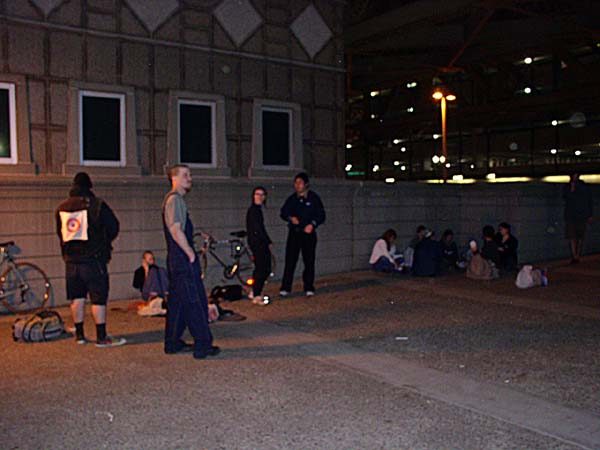
As of 11pm, the jail vigil was continuing with 12-15 people awaiting the release of arrestees from April 19's demonstration. It was not expected that anyone would be released until at least 2am.
A group waits
by gwen
Monday, Apr. 19, 2004 at 8:42 PM

Presenting the flag
by gwen
Monday, Apr. 19, 2004 at 8:42 PM
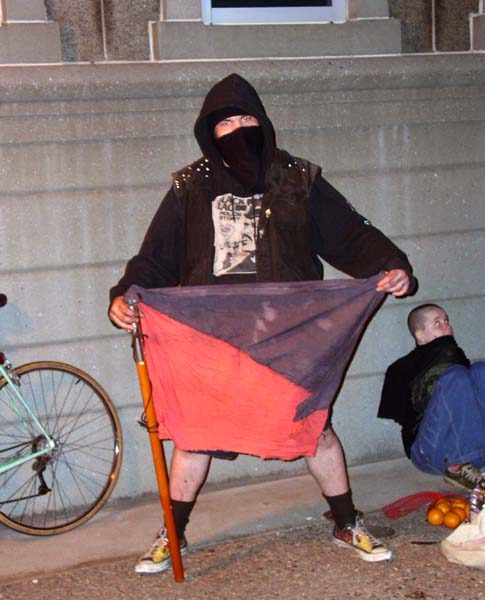
Having a Good Time
by Ashley
Wednesday, Apr. 21, 2004 at 8:45 AM
vegibeba@yahoo.com
My monday was a reletively peaceful day until one of my best friends called me from an obscure number to tell me that another one of our friends had been arrested. I understand the need to protect our president and keep the peace. I don't understand however, why some people choose to be police officers and judges. While I waited outside of the prison I decided to speak to some policemen. I was wearing a white suit jacket and looked very respectful, furthermore,I hadn't done anything to anger them but was made to feel as though I had just committed a crime. Apparently the men and women of the Pittsburgh police absolutely hate everyone who isn't involved in law enforcement. I assume this is true because of the complete lack of respect they've got for innocent bystanders, and the demeaning manner of speech and body language they employ toward "prisoners". It would seem to me that they insigate anger to have something to be angry about. Does this seem relevant? Have a really angry day police!
Ass-hley
by George K.
Wednesday, Apr. 21, 2004 at 11:12 AM
vine_swinger_chuckie@yahoo.com
Ashley,
Maybe they were really damn tired of hearing the same questions over and over again from the dirty rabble in the parking lot, that, by the time that you came along, they had pounding headaches.
Just looking at the Mujadeen letting his freak-flag fly in the recent phot is enough to send me into apoplectic fits.
Why the red-and-black flag?
by mujahid is the singular
Wednesday, Apr. 21, 2004 at 2:27 PM
The red-and-black flag has been associated with anarchism for some time. Murray Bookchin places the creation of this flag in Spain:
"The presence of black flags together with red ones became a feature of Anarchist demonstrations throughout Europe and the Americas. With the establishment of the CNT [in 1910], a single flag on which black and red were separated diagonally, was adopted and used mainly in Spain." [The Spanish Anarchists, p. 57]
However, there is plenty of evidence to suggest that the red-and-black flag spread across to other countries, particularly those with strong links to Spain (such as other Latin countries). For example, during the "Two Red Years" in Italy which culminated in the factory occupations of 1920 (see section A.5.5) the red-and-black flag was raised by workers in revolt [Gwyn A. Williams, Proletarian Order, p. 241] Similarly, Augusto Sandino, the radical Nicaraguan national liberation fighter was so inspired by the example of the Mexican anarcho-syndicalists during the Mexican revolution that he based his movement's flag on their red-and-black ones (the Sandinista's flag is divided horizontally, rather than diagonally). As historian Donald C. Hodges notes, Sandino's "red and black flag had an anarcho-syndicalist origin, having been introduced into Mexico by Spanish immigrants." Unsurprisingly, his flag was considered a "workers' flag symbolising their struggle for liberation." (Hodges refers to Sandino's "peculiar brand of anarcho-communism" suggesting that his appropriation of the flag indicated a strong libertarian theme to his politics). [Intellectual Foundations of the Nicaraguan Revolution, p. 49, p. 137, p. 19]
In the English speaking world, the use of the red-and-black flag by anarchists seems to spring from the world-wide publicity generated by the Spanish Revolution and Civil War in 1936. With CNT-FAI related information spreading across the world, the familiarity of the CNT inspired red-and-black flag also spread until it became a common anarchist and anarcho-syndicalist symbol in all countries.
For some, the red-and-black flag is associated with anarcho-syndicalism more than anarchism. As Albert Meltzer puts it, "[t]he flag of the labour movement (not necessarily only of socialism) is red. The CNT of Spain originated the red-and-black of anarchosyndicalism (anarchism plus the labour movement)." [Anarcho-Quiz Book, p. 50] Donald C. Hodges makes a similar point, when he states that "[o]n the insignia of the Mexico's House of the World Worker [the Mexican anarcho-syndicalist union], the red band stood for the economic struggle of workers against the proprietary classes, and the black for their insurrectionary struggle." [Sandino's Communism, p. 22]
George Woodcock also stresses the Spanish origin of the flag:
"The anarcho-syndicalist flag in Spain was black and red, divided diagonally. In the days of the [First] International the anarchists, like other socialist sects, carried the red flag, but later they tended to substitute for it the black flag. The black-and-red flag symbolised an attempt to unite the spirit of later anarchism with the mass appeal of the International." [Anarchism, p. 325f]
However, there are earlier recorded uses of the red-and-black flag, suggesting it was, perhaps, rediscovered by the Spanish Anarchists rather than invented by them. The earliest use of the red-and-black colours is during the attempted Italian insurrection of August 1874. While a failure, some of those involved were "sporting the anarchists' red and black cockade." In April 1877, a similar attempt at provoking rebellion saw anarchists enter the small Italian town of Letino "wearing red and black cockades and waving a banner of the same colours." These actions helped to "captur[e] national attention" and "draw considerable notice to the International and its socialist programme." [Nunzio Pernicone, Italian Anarchism, 1864-1892, p. 93, p. 124 and pp. 126-7] Both T. R. Ravindranathan [Bakunin and the Italians, p. 228] and George Woodcock record the same event and the same flag. being used. [Anarchism, p. 285]
There is also a report of the red-and-black flag being used by anarchists a few years later in Mexico. At an anarchist protest meeting on December 14th, 1879, at Columbus Park in Mexico City "[s]ome five thousand persons gathered replete with numerous red-and-black flags, some of which bore the inscription 'La Social, Liga International del Jura.' A large black banner bearing the inscription 'La Social, Gran Liga International' covered the front of the speaker's platform." The links between the Mexican and European anarchist movements were strong, as the "nineteenth-century Mexican urban labour-movement maintained direct contact with the Jura branch of the . . . European-based First International Workingmen's Association and at one stage openly affiliated with it." [John M. Hart, Anarchism and the Mexican Working Class, 1860-1931, p. 58 and p. 17]
Therefore, it is not surprising we find movements in Mexico and Italy using the same flags. Both were in the same anti-authoritarian International as the Jura federation and had close links with it. Both the Italian and Mexican anarchist movements were involved in the First International and its anti-authoritarian off-spring. Both, like the Jura Federation in Switzerland, were heavily involved in union organising and strikes. Given the clear links and similarities between the collectivist anarchism of the First International (the most famous advocate of which was Bakunin) and anarcho-syndicalism, it is not surprising that they used similar symbols. As Kropotkin argued, "Syndicalism is nothing other than the rebirth of the International -- federalist, worker, Latin." [quoted by Martin A. Miller, Kropotkin, p. 176] So a rebirth of symbols would not be a co-incidence.
Two other factors suggest that the combination of red and black flags was a logical development. Given that the black and red flags were associated with the Lyon's uprising of 1831, perhaps the development of the red-and-black flag is not too unusual. Similarly, given that the Black Flag was the "flag of strikes" (to quote Louise Michel -- see last section) it use with the red flag of the labour movement seems a natural development for a movement with anarchism and anarcho-syndicalism which bases itself on direct action and the importance of strikes in the class struggle.
However, in spite of these uses of the red-and-black flag in the late 1870s, it seems to have fallen into disuse and it was only with the founding of the CNT over 30 years later in Spain that it was used again on a wide scale.
Over time association with anarcho-syndicalism has become less noted, with many non-syndicalist anarchists happy to use the red-and-black flag (many anarcho-communists use the red-and-black flag, for example). It would be a good generalisation to state that social anarchists are more inclined to use the red-and-black flag than individualist anarchists are social anarchists are usually more willing to align themselves with the wider socialist and labour movements than individualists (in modern times at least).
Thus the red-and-black flag comes from the experience of anarchists in the labour movement and is particularly associated with anarcho-syndicalism. The black represents libertarian ideas and strikes (i.e. direct action), the red represents the labour movement. However, it has become a standard anarchist symbol as the years have went by, with the black still representing anarchy and the red social co-operation or solidarity. Thus the red-and-black flag more than any one symbol symbolises the aim of anarchism ("Liberty of the individual and social co-operation of the whole community" [Peter Kropotkin, Act for Yourselves, p. 102]) as well as its means ("[t]o make the revolution, the mass of workers will have to organise themselves. Resistance and the strike are excellent means of organisation for doing this" and "the strike develops the sentiment of solidarity." [Peter Kropotkin, quoted by Caroline Cahm, Kropotkin and the Rise of Revolutionary Anarchism: 1872-1186, p. 255 and p. 256]).
www.infoshop.org/faq/index.html
