community-based, non-corporate, participatory media
Palestinians Are Being Denied the Right of Non-Violent Resistance?
by Jonathan Cook
Saturday, Dec. 02, 2006 at 2:48 AM
If one thing offers a terrifying glimpse of where the experiment in human despair that is Gaza under Israeli siege is leading, it is the news that a Palestinian woman in her sixties -- a grandmother -- chose last week to strap on a suicide belt and explode herself next to a group of Israeli soldiers invading her refugee camp.
Would HRW Have Attacked Martin Luther King, Too?
Palestinians Are Being Denied the Right of Non-Violent Resistance?
By JONATHAN COOK
in Nazareth
If one thing offers a terrifying glimpse of where the experiment in human despair that is Gaza under Israeli siege is leading, it is the news that a Palestinian woman in her sixties -- a grandmother -- chose last week to strap on a suicide belt and explode herself next to a group of Israeli soldiers invading her refugee camp.
Despite the "Man bites dog" news value of the story, most of the Israeli media played down the incident. Not surprisingly: it is difficult to portray Fatma al-Najar as a crazed fanatic bent only the destruction of Israel.
It is equally difficult not to pause and wonder at the reasons for her suicide mission: according to her family, one of her grandsons was killed by the Israeli army, another is in a wheelchair after his leg had to be amputated, and her house had been demolished.
Or not to think of the years of trauma she and her family have suffered living in a open-air prison under brutal occupation, and now, since the "disengagement", the agonising months of grinding poverty, slow starvation, repeated aerial bombardments, and the loss of essentials like water and electricity.
Or not to ponder at what it must have been like for her to spend every day under a cloud of fear, to be powerless against a largely unseen and malign force, and to never know when death and mutilation might strike her or her loved ones.
Or not to imagine that she had been longing for the moment when the soldiers who have been destroying her family's lives might show themselves briefly, coming close enough that she could see and touch them, and wreak her revenge.
Yet Western observers, and the organisations that should represent the very best of their Enlightenment values, seem incapable of understanding what might drive a grandmother to become a suicide bomber. Their empathy fails them, and so does their humanity.
Just at the moment Fatma was choosing death and resistance over powerlessness and victimhood -- and at a time when Gaza is struggling through one of the most oppressive and ugly periods of Israeli occupation in nearly four decades -- Human Rights Watch published its lastest statement on the conflict. It is document that shames the organisation, complacent Western societies and Fatma's memory.
In its press release "Civilians Must Not Be Used to Shield Homes Against Military Attacks", which was widely reported by the international media, HRW lambasts armed Palestinian groups for calling on civilians to surround homes that have been targeted for air strikes by the Israeli military.
Noting almost as an afterthought that more than 1,500 Palestinians have been made homeless from house demolitions in the past few months, and that 105 houses have been destroyed from the air, the press release denounces Palestinian attempts at non-violent and collective action to halt the Israel attacks. HRW refers in particular to three incidents.
On November 3, Hamas appealed to women to surround a mosque in Beit Hanoun where Palestinian men had sought shelter from the Israeli army. Israeli soldiers opened fire on the women, killing two and injuring at least 10.
And last week on two separate occasions, crowds of supporters gathered around the houses of men accused of being militants by Israel who had received phone messages from the Israeli security forces warning that their families' homes were about to be bombed.
In language that would have made George Orwell shudder, one of the world's leading organisations for the protection of human rights ignored the continuing violation of the Palestinians' right to security and a roof over their heads and argued instead: "There is no excuse for calling [Palestinian] civilians to the scene of a planned [Israeli] attack. Whether or not the home is a legitimate military target, knowingly asking civilians to stand in harm's way is unlawful."
There is good reason to believe that this reading of international law is wrong, if not Kafkaesque. Popular and peaceful resistance to the oppressive policies of occupying powers and autocratic rulers, in India and South Africa for example, has always been, by its very nature, a risky venture in which civilians are liable to be killed or injured. Responsibility for those deaths must fall on those doing the oppressing, not those resisting, particularly when they are employing non-violent means. On HRW's interpretation, Mahatma Gandhi and Nelson Mandela would be war criminals.
HRW also applies a series of terrible double standards in this press release.
It refuses Palestinians the right to protect homes from attack, labelling these civilians "human shields", even while admitting that most of the homes are not legitimate military targets, and yet it has not said a word about the common practice in Israel of building weapons factories and army bases inside or next to communities, thereby forcing Israeli civilians to become human shields for the army.
And HRW prefers to highlight a supposed violation of international law by the Palestinians -- their choice to act as "human shields" -- and to demand that the practice end immediately, while ignoring the very real and continuing violation of international law committed by Israel in undertaking punitive house demolitions against Palestinian families.
But let us ignore even these important issues and assume that HRW is technically correct that such Palestinian actions do violate international law. Nonetheless, HRW is still failing us and mocking its mandate, because it has lost sight of the three principles that must guide the vision of a human rights organisation: a sense of priorities, proper context and common sense.
Priorities: Every day HRW has to choose which of the many abuses of international law taking place around the world it highlights. It manages to record only a tiny fraction of them. The assumption of many outsiders may be that it focuses on only the most egregious examples. That would be wrong.
The simple truth is that the worse a state's track record on human rights, the easier ride it gets, relatively speaking, from human rights organisations. That is both because, if abuses are repeated often enough, they become so commonplace as to go unremarked, and because, if the abuses are wide-ranging and systematic, only a small number of the offences will be noted.
Israel, unlike the Palestinians, benefits in both these respects. After four decades of reporting on Israel's occupation of the Palestinians, HRW has covered all of Israel's many human rights-abusing practices at least once before. The result is that after a while most violations get ignored. Why issue another report on house demolitions or "targeted assassinations", even though they are occurring all the time? And, how to record the individual violations of tens of thousands of Palestinians' rights every day at checkpoints? One report on the checkpoints once every few years has to suffice instead.
In Israel's case, there is an added reluctance on the part of organisations like HRW to tackle the extent and nature of Israel's trampling of Palestinian rights. Constant press releases denouncing Israel would provoke accusations, as they do already, that Israel is being singled out -- and with it, the implication that anti-Semitism lies behind the special treatment.
So HRW chooses instead to equivocate. It ignores most Israeli violations and highlights every Palestinian infraction, however minor. This way it makes a pact with the devil: it achieves the balance that protects it from criticism but only by sacrificing the principles of equity and justice.
In its press release, for example, HRW treats the recent appeal to Palestinians to exercise their right to protect their neighbours, and to act in soldarity with non-violent resistance to occupation, as no different from the dozens of known violations committed by the Israeli army of abducting Palestinian civilians as human shields to protect its troops.
Women vounteering to surround a mosque become the equivalent of the notorious incident in January 2003 when 21-year-old Samer Sharif was handcuffed to the hood of an army Jeep and driven towards stone-throwing youngsters in Nablus as Israeli soldiers fired their guns from behind his head.
According to HRW's approach to international law, the two incidents are comparable.
Context: The actions of Palestinians occur in a context in which all of their rights are already under the control of their occupier, Israel, and can be violated at its whim. This means that it is problematic, from a human rights perspective, to place the weight of culpability on the Palestinians without laying far greater weight at the same time on the situation to which the Palestinians are reacting.
Here is an example. HRW and other human rights organisations have taken the Palestinians to task for the extra-judicial killings of those suspected of collaborating with the Israeli security forces.
Although it is blindingly obvious that the lynching of an alleged collaborator is a violation of that person's fundamental right to life, HRW's position of simply blaming the Palestinians for this practice raises two critical problems.
First, it fudges the issue of accountability.
In the case of a "targeted assassination", Israel's version of extra-judicial killing, we have an address to hold accountable: the apparatus of a state in the forms of the Israeli army which carried out the murder and the Israeli politicians who approved it. (These officials are also responsible for the bystanders who are invariably killed along with the target.)
But unless it can be shown that the lynchings are planned and coordinated at a high level, a human rights organisation cannot apply the same standards by which it judges a state to a crowd of Palestinians, people gripped by anger and the thirst for revenge. The two are not equivalent and cannot be held to account in the same way. Palestinians carrying out a lynching are commiting a crime punishable under ordinary domestic law; while the Israeli army carrying out a "targeted assassination" is commiting state terrorism, which must be tried in the court of world opinion.
Second, HRW's position ignores the context in which the lynching takes place.
The Palestinian resistance to occupation has failed to realise its goals mainly because of Israel's extensive network of collaborators, individuals who have usually been terrorised by threats to themselves or their family and/or by torture into "co-operating" with Israel's occupation forces.
The great majority of planned attacks are foiled because one member of the team is collaborating with Israel. He or she not only sabotages the attack but often also gives Israel the information it needs to kill the leaders of the resistance (as well as bystanders). Collaborators, though common in the West Bank and Gaza, are much despised -- and for good reason. They make the goal of national liberation impossible.
Palestinians have been struggling to find ways to make collaboration less appealing. When the Israeli army is threatening to jail your son, or refusing a permit for your wife to receive the hospital treatment she needs, you may agree to do terrible things. Armed groups and many ordinary Palestinians countenance the lynchings because they are seen as a counterweight to Israel's own powerful techniques of intimidation -- a deterrence, even if a largely unsuccessful one.
In issuing a report on the extra-judicial killing of Palestinian collaborators, therefore, groups like HRW have a duty to highlight first and with much greater emphasis the responsibility of Israel and its decades-long occupation for the lynchings, as the context in which Palestinians are forced to mimic the barbarity of those oppressing them to stand any chance of defeating them.
The press release denouncing the Palestinians for choosing collectively and peacefully to resist house demolitions, while not concentrating on the violations committed by Israel in destroying the houses and using military forms of intimidation and punishment against civilians, is a travesty for this very same reason.
Common sense: And finally human rights organisations must never abandon common sense, the connecting thread of our humanity, when making judgments about where their priorities lie.
In the past few months Gaza has sunk into a humanitarian disaster engineered by Israel and the international community. What has been HRW's response? It is worth examining its most recent reports, those on the front page of the Mideast section of its website last week, when the latest press release was issued. Four stories relate to Israel and Palestine.
Three criticise Palestinian militants and the wider society in various ways: for encouraging the use of "human shields", for firing home-made rockets into Israel, and for failing to protect women from domestic violence. One report mildly rebukes Israel, urging the government to ensure that the army properly investigates the reasons for the shelling that killed 19 Palestinian inhabitants of Beit Hanoun.
This shameful imbalance, both in the number of reports being issued against each party and in terms of the failure to hold accountable the side committing the far greater abuses of human rights, has become the HRW's standard procedure in Israel-Palestine.
But in its latest release, on human shields, HRW plumbs new depths, stripping Palestinians of the right to organise non-violent forms of resistance and seek new ways of showing solidarity in the face of illegal occupation. In short, HRW treats the people of Gaza as mere rats in a laboratory -- the Israeli army's view of them -- to be experimented on at will.
HRW's priorities in Israel-Palestine prove it has lost its moral bearings.
Jonathan Cook is a writer and journalist based in Nazareth, Israel. He is the author of the forthcoming "Blood and Religion: The Unmasking of the Jewish and Democratic State" published by Pluto Press, and available in the United States from the University of Michigan Press. His website is http://www.jkcook.net
http://www.counterpunch.org/cook11302006.html
Yeah, folks. Maybe Rosa Parks should have BLOWN up that bus, instead
by ignoring the man behind the curtain
Sunday, Dec. 03, 2006 at 8:32 AM
Yep. We should ignore egregious human rights violations commited by the palestinians- we should ignore the use of child soldiers, of human shields, and of persistent terror attacks on Israeli civilians. And we should ignore them, well...just because.
Zionism is Racism
by Zionism is Racism
Sunday, Dec. 03, 2006 at 3:05 PM
Notice how the right wing psychopath zionists will try to deflect attention away from Israel's terrorism toward the people of Palestine and blame the victim. Just like with the African Americans here in the U.S.
deflecting attention
by just wondering
Sunday, Dec. 03, 2006 at 7:40 PM
You mean, as in deflecting attention from the PaliNazis strapping bombs to children?
Oh yeah, to ignore blowing Israeli children is the essence of mental health, ain't that right?
Zionism is Racism
by Zionism is Racism
Monday, Dec. 04, 2006 at 9:40 PM
1. Action Alert - New Republic Defamation of Rachel Corrie
2. Nonviolent Resistance is not Illegal: HRW Should Retract Statement
3. Protesters get a mauling in Bil’in
4. The olive doesn’t fall far from the tree
5. Humanity lost
6. Newbury News: “Peace worker’s tales of war”
1. Action Alert - New Republic Defamation of Rachel Corrie
Please write letters to the New Republic:
Yesterday, the New Republic ran a review of the play My Name is Rachel Corrie by
James Kirchick and an opinion piece by Cynthia Ozick, both of which defame the
memory of Rachel Corrie and the organization she conducted her human rights work
with, the International Solidarity Movement. Please let the New Republic know that
you do not agree with Kirchick’s and Ozick’s characterization of both Rachel and the
ISM. Send letters to: online [at] tnr.com.
• ISM is on the side of international law and numerous UN resolutions blatantly
violated by decades of Israeli Occupation.
• ISM is strictly involved in non-violent resistance.
• The FBI does not consider the ISM to be a terrorist organization nor does any
other government agency in the US or abroad.
• The Israeli government has not declared ISM an illegal organization and has
failed to prove any connection between terrorist activity and ISM’s work.
• ISM works with several groups who advocate for a just peace in Palestine:
Rabbis for Human Rights, The Christian Peacemakers Team, International Women’s Peace
Service and the Israeli Committee Against House Demolitions.
• One of ISM’s founders, Dr. Ghassan Andoni was recently nominated for the Nobel
Peace Prize along with Jeff Halper, co-founder of the Israeli Committee Against
House Demolition.
• The Israeli government has failed to prove that there were any weapons tunnels
under the home Rachel Corrie died defending.
• The Israeli government has never accused Samir or Khaled Nasrallah, the owners
of the home Rachel died defending, or their wives or children of links to terrorism.
• Rachel’s accounts of destruction in Rafah generally correspond with the
descriptions and conclusions of respected third party organizations like Human
Rights Watch and Amnesty International.
*****************************************
2. Nonviolent Resistance is not Illegal: HRW Should Retract Statement
On Sunday, Nov. 19, hundreds of Palestinian civilians crowded into the building
where the family of Mohammed Baroud and a number of other families live in Jabalya
refugee camp in the Gaza Strip. Israeli military forces had warned that the building
would be attacked. The planned Israeli attack was deterred by this action. Two hours
later, the scene was replicated at the family home of Mohammed Nawajeh, with the
same results.
The International Solidarity Movement (ISM) applauds the people of Jabalya for their
courageous and effective use of nonviolent resistance, and we express our full
solidarity with their actions, which are positive initiatives in the struggle to
defend Palestinian rights. We encourage international volunteers to participate in
these actions, as did Father Peter Dougherty and Sister Mary Ellen Gundeck of the
Michigan Peace Team.
We note with disappointment that Human Rights Watch (HRW) chose to condemn these
actions, suggesting that they could constitute a “war crime.” In a November 22, 2006
press release entitled, “OPT: Civilians Must Not Be Used to Shield Homes Against
Military Attacks” HRW Middle East Director Sarah Leah Whitson said, “There is no
excuse for calling civilians to the scene of a planned attack. Whether or not the
home is a legitimate military target, knowingly asking civilians to stand in harm’s
way is unlawful.”
HRW’s press release is factually, legally, and morally flawed.
HRW based its statement on contested factual information. HRW claimed that
“Palestinian armed groups” and Mohammed Baroud encouraged civilians to gather around
the homes. However, while some press accounts mention Baroud’s role, numerous other
press and participant accounts from Gaza suggest that the mobilizations resulted
from calls by civilian leaders and a groundswell of popular anger against Israeli
home demolitions.
As just one example, Eyad Bayary, a head nurse at Jabalya Hospital who went to
Baroud’s home with another twenty of his neighbors, told ISM that he did not hear a
call from Baroud asking people to protect his home. He and his neighbors went to
support Baroud and his family and to protest the shelling out of their own volition.
“I live next to Mr. Baroud’s family home. If his home is shelled at best my home
would be damaged. My wife is in the six month of her pregnancy. God forbid, a
shelling of the house next door could endanger her and the child she is carrying.
All our children would be affected. We went to the Baroud family house because we
were scared and angry. No one asked us to come.”
In addition to this factual weakness, we believe that HRW’s position reflects
serious errors in the interpretation and application of international humanitarian
law (IHL), in two fundamental respects: (1) HRW’s position explicitly rejects
considering the legitimacy of the target as relevant to the legal analysis; and (2)
HRW’s position erroneously places the burden of protecting civilian lives on the
population being attacked instead of on the belligerents carrying out the attack.
According to HRW, “In the case where the object of attack is not a legitimate
military target, calling civilians to the scene would still contravene the
international humanitarian law imperative for parties to the conflict to take all
feasible precautions to protect civilians from the effects of attack.” IHL clearly
makes target legitimacy central to the determination of lawful vs. unlawful conduct.
Protocol I of the Geneva Convention, Article 51(7) provides that “Parties to the
conflict shall not direct the movement of the civilian population or individual
civilians in order to attempt to shield military objectives from attacks or to
shield military operations.” Article 52 of the same Protocol makes clear that a
civilian home is a civilian object and not a military objective. Even if Mohammed
Baroud and Mohammed Nawajeh are military commanders, their families, their family
homes and the homes of other families in the same buildings are not military
objectives.
Therefore, the Geneva Convention’s prohibition on the use of civilians to shield
military objectives does not apply to the voluntary gathering of Palestinian
civilians to protect civilian objects like the homes of Baroud and Nawajeh from a
pending Israeli attack. Rather, Israel’s targeting of these homes constitutes a
violation of numerous provisions of IHL that proscribe attacks on civilian property,
and of Article 33 of the Fourth Geneva Convention, strictly prohibiting the
destruction of property for the purpose of collective punishment.
While IHL places obligations on all parties to a conflict to take “all feasible
precautions” to protect civilians from the effects of attack, HRW does not cite
support for its claim that encouraging civilians to defend their homes from military
strikes constitutes a violation of this imperative. In fact, Protocol I, Article 57
relating to precautions in attack, specifically places the obligation to protect
civilians on “those who plan or decide upon an attack.” (Protocol I, Art. 57(2)(a)).
Furthermore, providing warning does not absolve Israel of its responsibility not to
attack civilian objects, nor does it make the civilian objects legitimate military
targets.
The error of HRW’s interpretation of IHL is even more obvious when we consider that
HRW statements like “Civilians Must Not Be Used to Shield Homes Against Military
Attacks” and “knowingly asking civilians to stand in harm’s way is unlawful” would
proscribe many completely legitimate forms of nonviolent resistance in occupied
peoples’ struggles. The Fourth Geneva Convention and its Additional Protocols were
never intended to permit an aggressor to choose his targets at will, while putting
the onus on the civilian victims to get out of the way. Nor were these laws created
to prevent civilians from exercising their right to defend their property.
The condemnation of nonviolent efforts by civilians to prevent the destruction of
civilian homes also represents a failure of moral judgment on the part of HRW. To
condemn nonviolent actions in this way is to confuse civil resistance with the
forcible use of “human shields” by military combatants, such as those documented by
the Israeli human rights organization B’Tselem in its November, 2002 report “Human
Shield”. The report describes Israeli military seizures of Palestinian civilians,
forcing them to walk in front of soldiers and sometimes placing them on the hoods of
their vehicles to deter attacks against their military personnel. These Israeli
military actions are clearly war crimes (though HRW failed to label them as such in
its April, 2002 report, “In a Dark Hour: The Use of Civilians during IDF Arrest
Operations”). It is a mistake to extend this principle to the courageous voluntary
participation of unarmed individuals in mass nonviolent actions in defe!
nse of their human rights.
By condemning nonviolent civilian resistance in this way, HRW endangers those
practicing it, and undermines the work of other human rights groups and the
credibility of HRW itself. ISM calls upon HRW to retract its November 22 press
release and to recognize the courage and the legitimacy of the actions of the
Palestinian community in Jabalya.
***********************************
3. Protesters get a mauling in Bil’in
At today’s peaceful protest against the apartheid wall in Bil’in the IOF lashed out
at activists with fists and batons, and arrested one Israeli activist. One activist
had blood streaming down his face from the assault and had to have his head bandaged
by medics on the scene.
Soon after the start of the smaller than average march the intentions of the IOF
were clear. Soldiers had positioned themselves on the roof of a house at a junction
inside the village, and were visible in large numbers lining the route of the march.
When the villagers reached the gate in the wall with their tractor, they demanded
access to their land on the other side. Being denied access, the protesters set
about dismantling the razor wire in front of the gate. Despite a barrage of sound
bombs and some tear gas much of the wire was removed. Unable to disperse the small
but determined crowd, the soldiers called in reinforcements and escalated their
military violence. They climbed over the gate to target one protester, whilst
ruthlessly dealing with anyone in their way.
Several people suffered cuts and torn clothes, as well as the head injuries suffered
by a villager and an Israeli activist. The arrested Israeli was badly beaten and had
his shirt torn off. He is still in detention.
Back in the village soldiers were shooting rubber bullets and tear gas at the
village children. Two children were shot, one in the head and the other in the back
and legs. The brutality shown by the IOF and their large presence inside Bilin
today, marks another escalation in their efforts to quash the village’s non-violent
resistance that has captured the imagination of peace activists from all over the
world.
For photos see: http://www.palsolidarity.org/main/2006/12/01/bilin-1-12-06/
********************************
4. The olive doesn’t fall far from the tree
by Joey Weinberg
Today (Thursday, Nov 16) is definitely a good day to pick some olives; in fact, with
the heavy rain from yesterday, it is even better that we are doing this as soon as
possible. Too much rain makes problems for the harvest and for the olives harvested
(I’m not sure why but too much water is no good), so it is good that we’re
harvesting today. Full of early morning coffee and tea, we are going to pick olives
with a couple of Faroun villagers in their olive groves, which lie across the street
from the village (just south of Tulkarem). So, if you live in Faroun and have land
that you want to get to, all you have to do is cross a street.
I rarely think of crossing a street as difficult, but our friend Yusef has to go
through a lot of trouble to cross this street. Immediately on either side of the
street is a tall fence loaded with electronic sensors; on either side of this fence
is a wide pathway, then another fence, then a bunch of razor wire, and then a
trench.
You see, like so many Palestinian villages, Jawad’s village, Faroun, is cut off from
its agricultural land by Israel’s annexation wall. Just like Bil’in, Jayyus and many
other rural communities, the main road through the village comes to a dead end at
the annexation fence. Unlike the two other villages I named though, at the place
where the main road through Faroun meets the annexation fence there is no gate
through which to pass, so access is a bit trickier. So, early this morning, like we
did yesterday morning, I, a few foreigners and our friend Yusef start our trek
through the village of Faroun to Faroun’s agricultural land by walking around the
village — yes, around the village.
The nearest point of access between Faroun the village and Faroun the agricultural
land is off a road that goes around the village. This road around the village has a
turnoff which comes to an end at an Israeli checkpoint. On the other side of this
checkpoint is a road which goes directly to Jawad’s land, but the road is a
restricted access road open only to Israelis and the few native Palestinians who
hold Israeli work permits. To access the 4500 dunums (roughly 900 acres) of Faroun
land which lie between the Green Line and Israel’s annexation fence, the Faroun
residents must first get a permit from Israel, and those with permits must travel an
additional 7-9km to the Jubara checkpoint to present their permit to the soldiers.
Even with the permit, access ultimately depends on the discretion of the Israeli
soldiers stationed at the checkpoint.
For the first time in two years, Israel has granted Yusef access to his land, and he
now carries a permit good for one month. Even with this permit, there are some
additional barriers: the nearest point of access to his land, where the village road
meets the Israeli road, is at this checkpoint through which, technically, he is not
allowed to pass.
You see, Yusef’s land access permit is meaningless at the nearest checkpoint, as it
only allows him access to his land, not to the State of Israel, and the road to his
land is officially claimed as part of the State of Israel. However, this morning we
decide that, since Yusef has four foreigners with him, we’d try to pass through this
checkpoint, hoping that, in the presence of foreigners, the Israeli soldiers would
let everyone through. We successfully passed through with Jawad yesterday, so why
not try again?
This early in the morning there is no line. As we reach the checkpoint, the casual
interrogation begins. “Why are you here?”, “Where are you from, etc.” Yusef hands
over his permit, and, after another soldier arrives to debate the status of this
permit, the first soldier turns to me and says, “You can pass here, but he cannot
pass.” To which we ask, “Why? He lives here — his olive grove is just 100 meters up
this road. Why can foreigners pass and this man can’t? We think it’s ridiculous that
we can go to his land and he can’t. What is the problem?”
To this the second soldier replied, “It is complicated, but…” and explained that, as
mentioned earlier, only Israelis or those who have a permit to work in Israel can
pass. After about thirty minutes trying to get the soldier to change his mind –”this
is silly, we’re only going 100 meters down the road, can you call your superiors,
etc.”– a commander offers Yusef a compromise. “You can escort them to the land, then
you must return here and go around to pass through the proper checkpoint.” This is
just too stupid to be real. Yusef heads back to catch a ride to the Jubara
checkpoint, and the four of us walk up the restricted road to his land.
We arrive in the grove to find Yusef’s cousin and his mother pouring the tea, so we
have some tea and get started right away. First, we lay plastic tarp on the ground,
then some of us start stripping the tree of olives ether by hand or with a small,
hand-held rake, letting olives fall to the tarp beneath the tree. Cousin Raed –who
has a 3-month permit– and a family friend get in the trees to show us foreigners how
real work gets done.
Some of these trees are so loaded with olives that it takes a group of five people
one hour to finish one tree, but some of them are underdeveloped and don’t have much
fruit. For the small or underdeveloped trees, we don’t bother laying a tarp, instead
plucking the olives by hand and catching them with buckets or aprons. We get a
pretty good rhythm going: as some of us finish one tree, others get started on
another. We clear away two years of undergrowth and scrub brush to prepare the area
to lay a tarp down, then start plucking, yanking, raking, and picking olives. We
spend the rest of the morning repeating the process.
Occasionally one or two of us collect olives from the ground, and occasionally we
pass around a bottle of water. Occasionally one or two of us gets a bit winded from
the work or squints a bit too much from all the sunshine, and occasionally one of us
will make the others laugh by making monkey noises from up in an olive tree. My role
is not only to harvest but also to periodically munch on partially-dried olives.
Only once did I almost fall from a tree.
We stop for lunch at around 11:30AM; I don’t know where it came from; Um Yusef must
have carried it with her, because one minute she’s putting olives in buckets and the
next she’s telling us to sit and eat, which is probably my favorite thing to do
here. Maybe harvesting olives is a close second, but eating ranks pretty high.
People here like their guests to eat, and in this I fancy myself an overachiever. If
only my appetite matched my enthusiasm, I would be a Palestinian children’s story or
some sort of Saint for food-eaters. But it’s not only the food but the sharing — the
culture of collectivism I’m slowly getting accustomed to. Cooking Arabic coffee over
a campfire, sipping tea under an olive tree, and keeping such great company make it
quite easy to forget the utter stupidity, casual inhumanity and naked brutality of
the circumstances which have brought us here. At the moment I see no soldiers, no
police, no weapons, no racism and hate… and I am truly happy to be here. Should I
feel ashamed for having such a good time with Jawad, Ahmed, and the rest of our
hosts? It really doesn’t feel like work.
As the Palestinian olive harvest nears its end, I consider the persistence of these
farmers who continue to defy the theft and expropriation of their land: these
farmers are the last line of defense for Palestine’s very survival. In fact, the
olive harvest itself may be the biggest roadblock to a seemingly impending erasure
of a culture.
Of course you can discuss perhaps the economics of the olive, the olive tree, olive
oil and the region, but this resistance act is not an economic act. The travel
restrictions which make import/export unavailable to Palesinians renders any such
discussion almost pointless. The economics? There are none. Israel has pretty much
managed to sever the economic ties between the Palestinians and their most famous
domestic product –the olive– through travel restrictions. Under this occupation,
farming your olives is much less a profit venture than a necessary way to be what
you are. It is no longer profitable to maintain your groves, pick your olives, and
simply be what you are — an olive farmer. Hell, in some circumstances it is not even
possible.
So why continue? Why do these people bang their heads against the wall? Why spend
all available time jumping through Israel’s hoops to get permits, then walking one
or two hours out of the way just to work as an olive farmer and not make a living?
You could say that many of these farmers have nothing to gain and everything to
lose. The very fact that these farmers continue to work in their fields and on their
lands may be the biggest act of defiance and complete noncooperation I have seen:
they simply refuse to disappear. These people are as solid and as strong as the
hundreds-year-old trees they care for, as persistent as the thousands-year-old
traditions they keep. As they refuse to let the occupation kill their traditions and
their lands, they refuse to let the occupation kill their spirits.
You could say that the olive doesn’t fall far from the tree.
For photos visit http://www.palsolidarity.org/main/2006/12/02/joey-journal/
***********************************
5. Humanity lost
by Laila El-Haddad, November 29th
http://a-mother-from-gaza.blogspot.com/
We stood and we waited and we cried and we returned back to Egypt yesterday, and
again today. Us and thousands of others.
It was anguish. Anguish and misery and desperation personfied in every woman, man
and child.
One hour turned into two, then three, then five, as we stood shielding our eyes from
the piercing midday sun on Wednesday, when we were told the Crossing would be
opening for a few hours.
Some wailed in exhaustion, others fainted, still others cracked dry humor, trying to
pass the time. We stood, thousands of us, packed together elbow to elbow like
cattle, penned in between steel barriers on one end, and riot-geared Egyptian
security guards on the perimeter, who were given orders not to allow anyone through
until they hear otherwise from the Israelis-and to respond with force if anyone
dared.
Many of the people had been waiting for more than two weeks to cross back into Gaza,
sometimes making the trip to the crossing several times a day upon receiving word of
its imminent opening.
“We have been waiting for 15 days now. Only god knows when it will open-today,
tomorrow, the day after?” said 57-year-old Abu Yousuf Barghut, his shrapnel-riddled
arm trembling by his side.
His tearful wife, Aisha, added: “God knows we only went to seek treatment for him
and to come right back. And now we are stuck and waiting us in Gaza are my four
children. This is the most basic of rights-to be able to return to our homes, and we
are even denied that.”
“The only way anyone will actually pay attention to our plight is if one of us dies
here, and even then, I’m not sure the world will care,” stammered one young man,
Isam Shaksu, his eye heavily bandaged after having received an corneal implantation
in Jordan.
In July, seven Palestinians waiting to be let into Gaza from Egypt died waiting to
cross Rafah.
After the hours and the sun, one would have thought the black steel gates ahead of
us were the gates to Heaven, but in fact they only led to more masses, more waiting,
more hell.
There is something you feel as you stand there, and sometimes squatted, for hours at
a time, waiting to be let through the Egyptian side of Rafah Crossing. It is
something of your humanity slowing drifting away. It is gradual, but unmistakable.
And you are never quite the same again.
There were mixed Israeli orders-first to open the crossing for three days, starting
Wedneday, yesterday; then breaking news at 11pm retracted that order, and by
Wednesday morning, another about-face saying that the border would in fact be
opened. By the time we arrived, it was 11am, and already somewhere around 2000 has
amassed in front of the gates. And no one was budging.
Yousuf waited along with us, asking incessantly “When would the crossing open??”,
and begging me to pose the same quetion to the Egyptian officers manning it.
Everytime he’d see the gate budge open he would get excited and yell “Its open!! Its
open!!”. And everyone would heave a heavy sigh.
When we finally did make it inside the “Second sector” of the Egyptian side, the
relief was overwhelming-we had moved 50 metres!! And we could wait another four
hours if it meant we’d finally be allowed through. But instead we faced yet another
uncertain wait; it was like some sadistic game with no certain ending.
As we waited, we saw members of the Palestinian athletic teams heading to the Asian
games after a two week delay.
We also saw Ismail Haniya on his way out to his Arab tour. He stopped to mingle with
the desperate crowds, some hailing him, some complaining about how long they had
waited.
We finally learned that the crossing had been closed this entire time, and the
Egyptians were only allowing people through to give them some hope to cling on
to-and to prevent the masses from rioting, which has happened before.
We thought once he’d passed, we’d be allowed through. But it is then we learned that
Mahmud Zahar had crossed earlier that morning-carrying suitcases full of $20
million.
The European Monitors were not pleased. How could he not declare the money, and how
could he have the audacity to try and bring in money to feed his peole in the first
place??
They filed a “complaint” with the Israelis, who immediately told them to shut down
the crossing, without giving a reason, leaving thousands-including Yousuf, my
parents and I, stranded.
My mother and Yousuf had gone ahead of my father and I-and our bags-into the
terminal, and Yousuf fell asleep in the mosque. It was then that the officers had
informed us the crossing was no longer operational-and everyone who was inside, even
those who had already made it as far as the Palestinian side, would have to go back.
We pleaded with an Egyptian Officer: “It took us 6 hours to get as far the inside of
the terminal, please let us through”.
“Big deal-it took me ten hours to get here from Cairo,” he retorted, as I reminded
myself they get paid a measly 180 Egyptian pounds a month and couldn’t care less.
Another officer was more sympathetic.
“What you lot have to understand is that no one gives a damn what happens to you-you
could sit here and suffocate for all they care. You are simply not human enough for
them to care.”
When is it that we lost our humanity, I wondered? And when is it that the humanity
and desperation of a people, waiting desperately to be let through to their homes,
was less important than the call of duty? And that a government was made to choose
between feeding their own people, or giving them passage to their homes?
Inside the terminal, the scenes were dizzying. Already disoriented form lack of
sleep and little food, I looked around in awe. It was nothing short of an interment
camp, and I lost myself somewhere between the silent anguish of old men, aching,
teary eyed-women on the verge of collapse, and children, some strewn across the
floor in exhaustion, others who were sick, in wheelchairs, wailing…
We returned to Arish, exhausted and sleep deprived, only to find that all of the
apartments were occupied by returning passengers. The only flat we found was one
without hot water and leaky ceiling pipes, but we couldn’t care less. By 9pm we were
all out.
The next morning, we left again to the border-where we had left our
suitcases-despite word from taxi drivers that the crossing would not open. We waited
again, this time for only 5 hours, until we decided it was an exercise in futility.
Everyone was looking for answers-some answers, any answers. When would the crossing
open? Was there hope it would open today? If so, what time? Should we wait, should
we return to Arish? Nobody knew.
Every now and then someone would make a call to some secondary source they knew in
Gaza or on the border, and rumors would spread like wildfire across the masses. “At
noon-they say at noon there is a possibility it will open! Patience, patience!”.
And then we wait some more.
One man, frustrated, took his bags and began to push them back on a trolley and out
through the throngs of exhausted passengers.
“Where the hell do you think you’re going??” bellowed one of the Egyptian officers.
“To Jerusalem! Where do you think??” he snapped.
It was nearing the end of our long day, and overcome by exhaustion, we didn’t know
whether to laugh or cry.
A friend in the UN told me the Europeans had left their posts after yesterday’s
“incidents” and thus the Palestinian side of the crossing has shut down indefinitely
now.
And so now, we return to square one. Back in Arish, waiting, as ever, for the border
to open.
**************************************
6. Newbury News: “Peace worker’s tales of war”
by Neil Welch, December 1st
http://www.newburytoday.co.uk/News/Article.aspx?articleID=3394
Human rights worker teams up with Newbury shop owner to raise funds for the woman
who saved her life
A HUMAN rights worker who spent last Christmas in an Israeli jail has visited
Newbury to help raise money for the woman who saved her life.
Sharon, 33, won’t give out her surname as she fears Israeli authorities will use the
information to ban her from the country or lock her up again.
She gave a talk and showed a video at Friends Meeting House in Newbury on Wednesday
to highlight the plight of Palestinians in Israel.
Sharon was put in prison after being banned from a peace conference in Bethlehem on
December 21 last year, spending 11 days behind bars.
“It was ironic that I was trying to get to Bethlehem and they wouldn’t let me,” she
said.
Although her time in prison was hard, she wasn’t subjected to the same abuse as some
of her fellow peace workers.
“My colleague Vic was beaten by seven guards to try and convince him to get on the
plane back. They just shouted at the girls,” she said.
“Another peace worker arrived on Christmas Day and bought decorations and chocolate
coins – those were our presents.”
But this wasn’t the most difficult time in Sharon’s travails. On April 1, 2002,
Israeli soldiers opened fire on her and nine other peace workers at a protest. She
was left with near-fatal wounds.
“We had our hands in the air and were walking backwards,” she said.
“I was shot in the stomach.
“It was April Fools Day – and the first time the Israeli army had used live
ammunition on human rights workers.”
Sharon said that despite the bloodshed, the hospital was nearly empty because the
army wouldn’t let Palestinians out of their houses, even for medical attention.
“Children were spending the night in their homes with their dead parents,” she said.
It was in hospital that she met Abla, the nurse whose care helped save her life.
“Her dream was to study public health, and she couldn’t achieve that without outside
help,” Sharon said.
Jacqui’s Convenience Store, on the corner of Berkeley Road and Blenheim Road in
Newbury, is helping raise money for Abla, 29, with a collection tin.
The shop has raised around £170 so far, which has helped to put Abla through her
first two semesters at Al Quds University in Jerusalem.
Jacqui Finch, who owns the store, said she was glad to aid the cause.
“It’s great to help Abla achieve what she has done so far,” she said.
“People are happy to contribute when they hear her story – even school children are
putting their pennies in.”
Sharon, who is trained as a medic, works for the International Solidarity Movement,
a group made up of Israeli, Palestinian and Western human rights workers.
She visits the Middle East around three times a year, and spends her time in the UK
raising awareness of civilians’ plight.
And after spending last Christmas behind bars, she has no intention of relaxing with
some turkey and a glass of wine this year.
“I’ll probably go and work in Lebanon for Christmas,” she said.
*************************************
For more reports, journals and action alerts visit the ISM website at
http://www.palsolidarity.org
Please consider supporting the International Solidarity Movement’s work with a
financial contribution. You may donate securely through our website at
http://www.palsolidarity.org/main/donations/
--~--~---------~--~----~------------~-------~--~----~
Thank you for your continued interest and support for the International Solidarity
Movement!
Please consider a financial donation to help continue the important work of the ISM.
You may donate securely online at our website:
http://www.palsolidarity.org/main/donations
For more information, visit the ISM website at http://www.palsolidarity.org
PLEASE FORWARD THIS UPDATE WIDELY
counter argument
by not on the terrorist payroll
Monday, Dec. 04, 2006 at 10:08 PM
From the Hadith:
“The Day of Resurrection will not arrive until you make war on the Jews, until a Jew will hide behind a rock or tree, and the rock or tree will say: Oh Muslim, servant of Allah, here is a Jew behind me, kill him!’”
Two Children Shot Inside UNRWA School
by Israel's crimes
Tuesday, Dec. 05, 2006 at 9:04 AM
18 November 2006
Gaza – This Saturday afternoon two schoolchildren were shot and wounded inside UNRWA’s Beit Lahia Elementary School in the northern Gaza Strip.
At 15:10 hrs, while sitting at his desk in a first grade classroom, Ahmed Isam Abdel-Aziz, seven years old, was struck by a bullet to the head. The bullet, which first bounced off a window ledge, penetrated 3-5 millimeters into Ahmed’ skull.
Five minutes later, Rewa Khalid Al-Mabhouh, 12 years old, was shot in the leg. She had just entered the school’s eastern corridor to pick up her younger brother, since evacuation of the school was underway.
Both bullets entered the school from the north, and Israeli tanks were seen stationed on a hill, 1.5 kilometers north of the school.
Ahmed was taken to Adwa Hospital for removal of the bullet, and then to Gaza Eye Hospital for a check on his eyesight, which will require monitoring. Rewa’s left calf bone was fractured, and medical staffs on Saturday evening are working on removal of the bullet.
Condemning the shootings, UNRWA’s Gaza Field Director, John Ging, described it as “yet a other tragic incident in what has become a bewildering cycle of violence.”
Referring to yesterday’s UN General Assembly resolution, Ging stressed how this newest tragedy underscores the need for an international mechanism to protect civilian populations. “At present, children are not safe even in United Nations classrooms. We urgently need a solution.”
israelscrimes.blogspot.com/2006/11/two-children-shot-inside-unrwa-school.html
The plight of Palestinian child prisoners
by repost
Wednesday, Dec. 06, 2006 at 12:35 AM
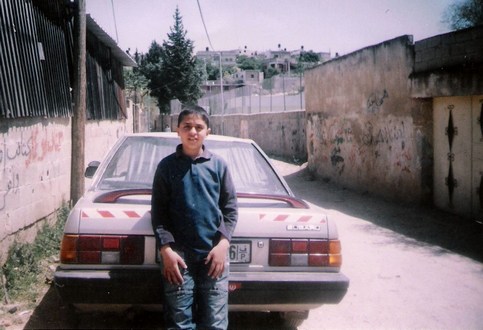
Report, IRIN, 5 December 2006
Child prisoner Layth Ghaleb Bedwan, 14, from Azoun village in the West Bank. (Naela Khalil/IRIN)
Palestinian Layth Ghalib Bedwan, 14, was arrested and detained by the Israeli authorities on 28 August 2006. Since then, his family has waited anxiously for him to return home.
"His mother is crying all the time. I contacted all the children's rights organisations in the hope that they can do something to accelerate the release of my son, but all my efforts were in vain," said Ghalib Bedwan, 36, Layth's father.
On 9 September, an Israeli military court accused Layth of throwing stones at Israeli soldiers, sentencing him to three months in prison, and imposing a US $400 fine on him.
"The occupation force stormed into our house at 2am in the morning on 28 August," his father said. "They were shouting and threatening to use their guns. They asked me to get my son Layth, and soon after they tied his hands, covered his eyes and put him in a military vehicle and drove away."
Activists say the manner of the arrest and detention of children like Layth contravenes international laws protecting children.
Iyad Misk is a lawyer for the NGO Defence for Children International (DCI) in the occupied Palestinian territories (OPT). He said international law allows for the detention of children or adolescents under 18, but under specific conditions.
"A specialised interrogator for children should interrogate them. The interrogation should be filmed and the parents should attend to be sure that the child was not subject to psychological pressure or abuse," Misk said.
He added that minors should appear before a special tribunal for children and only be detained in facilities dedicated exclusively for them, never with adults.
"All these conditions are not provided to Palestinian children detained by the Israeli authorities, although they do provide it for Israeli child prisoners," Misk said, adding that Israeli authorities try Palestinian children in military courts - another contravention of international law.
Misk said Article 37 of the UN's Convention on the Rights of the Child states that detaining children should be a measure of last resort, and must be for the shortest possible period of time. Israel signed this pact in 1990 but the NGO's lawyers say that it is only being applied to Israeli children.
Israel denies claims
Orit Stelser, a spokeswoman for Israel's prison service, denied that the conditions Palestinian child prisoners are held in, contravened international law. "Of course they don't break the law. There are lots of organisations, such as the Red Cross, who come to visit them and who check their conditions," she said.
She added that all Palestinian children and youths were now being held in separate blocks from their adult counterparts.
"About a month ago we took over Ofer Prison near Ramallah in the West Bank from the IDF [Israeli Defense Forces]. So we have changed all the rules there and the children are separated from the adults, and the boys from the girls," Stelser said.
"These young Palestinian terrorists get visited by their families twice a month - they have that right. Of course, we Israelis don't get to visit our prisoners, like Gilad Shalit [a soldier captured by Palestinian militants on 25 July] in Gaza, but we still guarantee the Palestinians their rights," she said.
There has been a marked increase in the number of Palestinian children detained in the West Bank since the start of the second intifada in 2000, a Palestinian uprising against Israeli occupation, according to the Palestinian Ministry for Prisoners Affairs and the NGO, Defence for Children International.
"Five thousand children have been either imprisoned or arrested in Israeli investigation centres for different periods of time since the start of the Intifada," said Dawood Dar'awi, head of the DCI office in OPT, adding that they were being detained for participation or "suspected participation" in intifada activities.
Dar'awi said 95 percent of detained children are from the West Bank and the rest from the Gaza Strip. This is because Israel maintains overall control over the West Bank and not the Strip, from where Israel disengaged in July 2005.
A landlocked territory bordering Jordan and Israel, the West Bank is home to 2.4 million Palestinian residents and some 400,000 Jewish settlers. As such, Israeli soldiers regularly patrol the streets and make arrests as they see fit.
The Palestinian Ministry for Prisoners' Affairs and children's rights activists like the DCI, confirmed the presence of about 450 Palestinian children from the West Bank in Israeli prisons, including three girls aged 15, 16 and 17. About 100 are ill, they said, three of them suffering from gunshot wounds.
* * * * *
This item comes to you via IRIN, a UN humanitarian news and information service, but may not necessarily reflect the views of the United Nations or its agencies. All IRIN material may be reposted or reprinted free-of-charge; refer to the copyright page for conditions of use. IRIN is a project of the UN Office for the Coordination of Humanitarian Affairs.
"xeroxed"
by logical fallacy
Wednesday, Dec. 06, 2006 at 7:43 PM
See:
http://pittsburgh.indymedia.org/news/2006/11/25282_comment.php#25467
Gaza's Realiy
by this is Zionism
Wednesday, Dec. 06, 2006 at 10:50 PM
Get this video and more at MySpace.com
israelscrimes.blogspot.com/2006/11/gazas-reality.html
Zionism is Racism
by Zionism is Racism
Thursday, Dec. 07, 2006 at 1:27 AM
Israel has decreed that my wife and I can no longer live together. I am Palestinian and she is Swiss and we have been married for 28 years. She was recently given two weeks to leave the occupied Palestinian territory. The Israeli Ministry of Interior wrote on her Swiss passport: "LAST PERMIT." We have been living together in Ramallah for 12 years. We came in 1994, when, after the Oslo Agreement, we were encouraged to move to the West Bank by the prospect of 'peace' and development.
My wife Anita speaks Arabic, likes the landscape, cooks Arabic meals, and she cares for my grandfather's village house -- an old stone building and the plants around it -- more than I do. She votes in Palestinian elections as the spouse of a Palestinian. She is active in serving the local society in public health. She has numerous friends here and considers it home. She still has her valuable European element and contacts, but she doesn't want to be separated from this environment or from me, and I certainly do not want to be separated from her. Our children are grown up and work abroad, but they are also not sure they will be allowed to visit us here. On her way to visit us in Ramallah a few months ago, our daughter, who has a Swiss passport, was delayed for six hours at Tel Aviv airport and grilled when she landed. She was lucky. Others are deported to where they took off from, often spending a night or more at the notorious detention 'facility' at the airport.
For the past 12 years, Anita has managed to stay here by diligently renewing her permit or leaving and coming back every three or six months to comply with the Israeli 'law' that applies in the occupied Palestinian territories. She is fighting now to stay here by going to a lawyer and to the Israeli courts, hoping for an injunction to be able to stay until a verdict is reached. She is also in touch with her embassy, and she has joined others in the same predicament in addressing the European Union and the American consulate, and in talking to human rights organizations, both Israeli and Palestinian, and the media.
We don't know what to do. But whatever it is, we have to do it quickly. What do we do about our shared life, our papers and accounts, the hundreds of little things that we have grown to share? What do we do about the new apartment that we made the 'mistake' of purchasing at the wrong time? She was keyed up about what tiles to choose and how to model the kitchen. We can't believe, or accept, that we are going to be separated. We believe it though, when we are reminded by other 'mixed' couples or families around us who have, and are being, separated.
More
http://electronicintifada.net/v2/article6174.shtml
Missed a big point here
by Palestinian atrocities
Thursday, Dec. 07, 2006 at 3:56 PM
Human rights Watch isn't condemning non-violent activities. They are condemning activities such as suicide bombing, and using women and children as human shields. Big difference
Zionist atrocities
by WWould you be able to live like this?
Thursday, Dec. 07, 2006 at 6:36 PM
Get this video and more at MySpace.com
israelscrimes.blogspot.com/2006/11/gazas-reality.html
Israeli Black Panthers support the Academic and Cultural Boycott of Israel
by legacy of the Panthers
Sunday, Dec. 10, 2006 at 10:39 PM
by Reuven Abarjel, introduction by Jeffrey Blankfort
During the late ‘60s and into the ‘70s, the reputation of the Black Panther Party for Self-Defense, which had its start in Oakland in 1966, spread far and wide, not only throughout the United States, but around the world, where the party was considered the leading arm of the Black liberation struggle in AmeriKKKa.
In Israel, the Black Panthers’ exploits caught the attention of the Mizrahi, dark-skinned Jews from North Africa and the Middle East – also known, less correctly, as Sephardim – who had been encouraged to come to the country following the expulsion of the Palestinians in the 1948 war.
While the Euro-American Ashkenazi Jews who dominated Israel’s founding Labour Party spoke of the “ingathering” of these immigrants as part of fulfilling the Zionist dream, in reality they were seen as inferior “human material” and were desired mainly as a source of cheap labor. As such, they were consigned to living situations which at times approximated the treatment of Mexican immigrants to America’s farmland. Some had their children kidnapped and given to childless Ashkenazi couples while others were used as guinea pigs in Nazi-like medical experiments.
What Asheknazi Israelis feared with the coming of the Mizrahi to Israel was what Israel’s first prime minister, David Ben-Gurion, described as the “Levantization” of Israeli society – Levant being another name for the Middle East. And so a process was begun to de-Arabize the Mizrahi, who, in every way other than religion, such as food, dress and culture, were much closer to the Palestinians and other Arab peoples than they were to the Euro-American Ashkenazis.
A key goal of this program was to make the Palestinians bitter enemies in the eyes of the Mizrahi, and one way they did that was to provide better protection to the Ashkenazi towns and settlements than to those of the Mizrahi. Thus, when the Palestinian fedayeen (fighters who were fighting to get back their land) would choose to attack an Israeli settlement, they would invariably choose a Mizrahi “development town” because it made an easier target.
In 1971, a group of Mizrahi saw through the Ashkenazis’ plans and began vigorously protesting the government’s racist policies that made them second class citizens, and they began identifying with the Palestinians. Someone, as the story goes, compared them to America’s Black Panthers, and the group eagerly adopted that name.
Their struggle lasted for a number of years, without any visible support from Israel’s Ashkenazi American Jewish supporters. Attempts to gain recognition as a group through the political system ended in disappointment
The unremitting and unapologetic racism on the part of Israel’s dominant Labour Party and even by some Ashkenazis who sympathized with the Palestinian struggle eventually caught up with it in 1977, when the right-wing Likud Party, under Menachem Begin, used promises and populist slogans to get the majority of the Mizrachim to vote for it and produce Israel’s first Likud prime minister.
In the 35th year since the birth of the Israeli Black Panthers, one of its founders, Reuven Abarjel, offered the following statement of solidarity with the Palestinian Campaign for the Academic and Cultural Boycott of Israel and the recent stand taken by NATFHE, the University and College Lecturers’ Union, in Britain, to boycott Israeli academic and institutions that have not taken a stand against Israel’s continuing occupation and oppression of the Palestinians. It was translated from the Hebrew by Smadar Lavie, an Israel Mizrahi academic who formerly attended UC Berkeley.
• Statement by Reuven Abarjel, founder of Israel’s Black Panthers, in support of the Academic and Cultural Boycott of Israel:
I was born in Morocco and have lived in Israel since 1950. In the 1970s, I founded the Black Panthers Movement. Our struggle against the regime was difficult and without compromise. The violence spread in the streets, and in order to break the Mizrahi resistance, the police acted with full force under the instructions of then prime minister Golda Meir.
From the onset of our struggle, the Black Panthers embarked on a dialogue with both local and European Palestinian leadership. Black Panthers delegations traveled to Italy, France, Belgium and the Netherlands. Concurrently, we met in refugee camps with bereaved families who lost their children to the struggle against the occupation. Just before Hon. Chairman Yasser Arafat died, I joined a delegation of activists who met with him in the besieged Muqata`a.
At the onset of our struggle, I began understanding that the problem is way deeper than I had thought, complicated to the extent that the average person finds it difficult to come up with solutions. The confusion is tremendous because the Israeli political system, maintained by external capitalist motives, causes the oppressed Palestinian and Mizrahi groups to collapse under the weight of the oppression and occupation.
The Mizrahim in Israel went through a sophisticated process of oppression under the guise of slogans such as “we are all brothers” and “we are all Jews.” While the Ashkenazi establishment beamed with “solidarity” toward us, it committed crimes against us, such as medical experiments in radioactive radiation of about 100,000 children, almost all of whom are immigrants from North Africa, the kidnapping of children from large Mizrahi families to transfer them to childless European Jewish couples, and the exclusion of Mizrahi Jews from Israel’s educational institutions and centers of influence.
It is the duty of every pacifist in this world, whether academic or not, to join the struggle against racist governments that practice discrimination against the minorities and disenfranchised groups who constitute their population. It is the duty of every pacifist to encourage these groups to raise their voice and enact their influence anywhere, especially in this highly charged region that threatens world peace.
I was glad to hear that a large group of British academics has raised an outcry and OKed a decision comprised of three demands:
(1) An end to the occupation;
(2) An end to the structural discrimination against the Palestinian citizens of Israel in the arena of education;
(3) A demand on Israel that its higher education system must reflect the majority of its citizenry. This majority is the Mizrahim.
These were some of the demands of the Black Panther Movement which I founded. Our struggle was against the racism, discrimination and oppression of the non-European populations of Israel and of the territories it occupied after 1967. Today I am a senior member of the Mizrahi Democratic Rainbow.
Here we are, 35 years later, when a large group of intellectuals is rising up, able to stand tall against the Zionist academic-political hegemony of Israel and of the world. Their resistance to this hegemony is not dependent on the wishes of Zionism and its followers. The importance of the boycott is not in the very act of boycotting, but in the resistive stand against the Israeli academy and its collaboration with Israel’s political hegemony.
Even though I am not an academic, I add my signature. I take pride in the struggles I conducted and still conduct against a violent force, which requires a larger force in order to restrain it. I hope that the ranks of the boycott will continue to grow until the occupation is over and racism and discrimination abolished.
Let blessings be bestowed upon you.
* * * * *
Reuven Abarjel may be reached by email at reuven_4@bezeqint.net or ederym13@bezeqint.net.
sfbayview.com/070506/israeliblack070506.shtml
stop Palestinian terror
by stop Palestinian terror
Tuesday, Dec. 12, 2006 at 2:30 PM
Stupid satement: "To accept compulsory population transfer in principle would set a dangerous precedent for international relations, and many nations would use such an excuse to cleanse themselves from "unwanted minorities"."
And yet, that is precisely what the world did with the 850,000 Jews that were expelled from Arab lands.
Is it kinder to let an entire population languish in camps for generations? As long as they are useful as pawns, apparently some feel this is acceptable. Comapssion be damned- thisis politics we are talking about!
stop Palestinian terror
by stop Palestinian terror
Tuesday, Dec. 12, 2006 at 2:31 PM
Stupid satement: "To accept compulsory population transfer in principle would set a dangerous precedent for international relations, and many nations would use such an excuse to cleanse themselves from "unwanted minorities"."
And yet, that is precisely what the world did with the 850,000 Jews that were expelled from Arab lands.
Is it kinder to let an entire population languish in camps for generations? As long as they are useful as pawns, apparently some feel this is acceptable. Compassion be damned- this is politics we are talking about!
Suggestions for better posting
by Etiquete police
Wednesday, Dec. 13, 2006 at 2:40 PM
Many articles are repeatedly posted here. They appear to be cut and pasted from sources such as the electronic infifada. It is much better etiquete to post a paragraph, linking to the full article With a note "for more information". Likewise, lists also take up too much space and render the threads hard to follow. Links are a better idea
The mind spins
by and everything goes black
Wednesday, Dec. 13, 2006 at 3:50 PM
"National self determination is racist by definition"
so, uh, national self determination for the Palestinians is also racist?
I'm soooo confused!!!!!!
It is impossible to simultaneously ignore
by Logic 101
Wednesday, Dec. 13, 2006 at 4:58 PM
and address someone. They are mutually preclusive.
